
This Rare Earth

I admire people who leave the house for purposes other than walking the dog. Brave people, exploring places beyond this suburb, they go out, then write about it eloquently, with physical knowledge.
For this and many other reasons, I love Jeremy Thomas Gilmer’s book, This Rare Earth: Building the Dams, Mines and Megaprojects that Run our World. It’s a recent collection of first-person essays about his experiences working for twenty-five years at vast mining operations all over the world: Peru, Bolivia, Democratic Republic of Congo, Columbia, Panama, Patagonia, Brazil, North Carolina, Northwest Territories, northwestern Ontario. Very hot and very cold places, through hurricanes, wildfires, loneliness, sleeplessness.
My forthcoming novel, Night Birds, was inspired in part by the collapse of a tailing pond in Brazil. I transferred an actual catastrophe at the Brumadinho dam in Brazil to a fictionalized catastrophe at a village commune in Romania. Jeremy Gilmer writes first-hand about the Brumadinho disaster, whereas I researched that and a comparative disaster in Romania through YouTube (economic necessity). Jeremy Gilmer went to Brazil to work: he’s skilled, experienced, useful.
Sometimes it seems that books are made only of words. Just as sleep is made of dreams. But Gilmer writes while he lives; his stories have been inhabited. His employment requires him to devote his intelligence to an industry that exploits mineral resources, a dangerous industry that can inflict generational damage on the environment that feeds it.
I was telling my brother about this book. My brother lives like a tortoise in a care home, because he’s disabled and getting old; he’s a funny and impossible person. Visits with him, as he becomes fossilized in the wash/repeat of a private institution, lulled by three good meals, soothed by underpaid angels, is like (he’s fond of analogies) – is like calling into a cave where water and light drip from a fracture in stone.
Yesterday, I was visiting my brother and needed to unpack my small parcel of stories from my outside world (which is very inside by the standards of Gilmer who goes to work at three o’clock in the morning inside a mountain in Peru). I was fishing for something to tell my brother who cannot handle much input as he ebbs toward ultimate forgetfulness. I tell him a bit about the unnerving world, I speak into the cave of my brother’s yawning mouth, past the dry bramble of his beard. He’s always astonished. He admits that he could never do on-site inspections of tailing dams in conflict zones. I couldn’t either. My brother knows himself, and sometimes this knowledge is disquieting, painful for him, and I urge him to forgive himself, as it’s too late anyway and he’s a rather wondrous though weird old soul.
Reading Gilmer’s beautiful book then talking about it to my brother is an experience of radical scale, the very large life requiring strength, endurance, courage VS a terrible minimalism that is without intentionality (like a writer without a story).
Here’s a passage from a chapter called “How to Fix a Mountain: Ancash, Peru, 2006.” Gilmer is looking down at a tailings dam that “stretched for more than a kilometre, a vast wall of earth and rock filling the space between two mountains. As a member of the construction management team, I’d been coming to this copper mine for years, watching the dam take shape. … But there was a problem.” The team has realized that one side of the valley is made up of a type of limestone “riddled with natural cavities and channels, raising the risk that water and tailings could seep through. … we needed to alter the rock….” The design team in Canada and Peru decided to “use a method called grouting.”
Even I know what grouting is – around a bathtub.
Gilmer writes: “I have experienced a few direct examples of the Anthropocene, the idea that we have reshaped the environment so much we now control its course. But nothing made it feel more absolute than this exercise: we altered a mountain. … The grouting program took years to complete, with crews of drillers, engineers, and technicians pushing through grueling shifts, day and night. It broke people. For every two who stayed, one left, undone by the altitude, the hours, the isolation. For those who embraced the science, endured the effort, the reward was unmatched. It wasn’t glamorous. But standing on a platform bolted into the mountainside, watching headlamps flicker in the blackness below, and listening to the steady rhythm of men carrying on through the night, we had discovered something close to devotion.”
Jeremy Thomas Gilmer’s book, This Rare Earth: Building the Dams, Mines and Megaprojects that Run our World, was published by Véhicle Press in 2025.
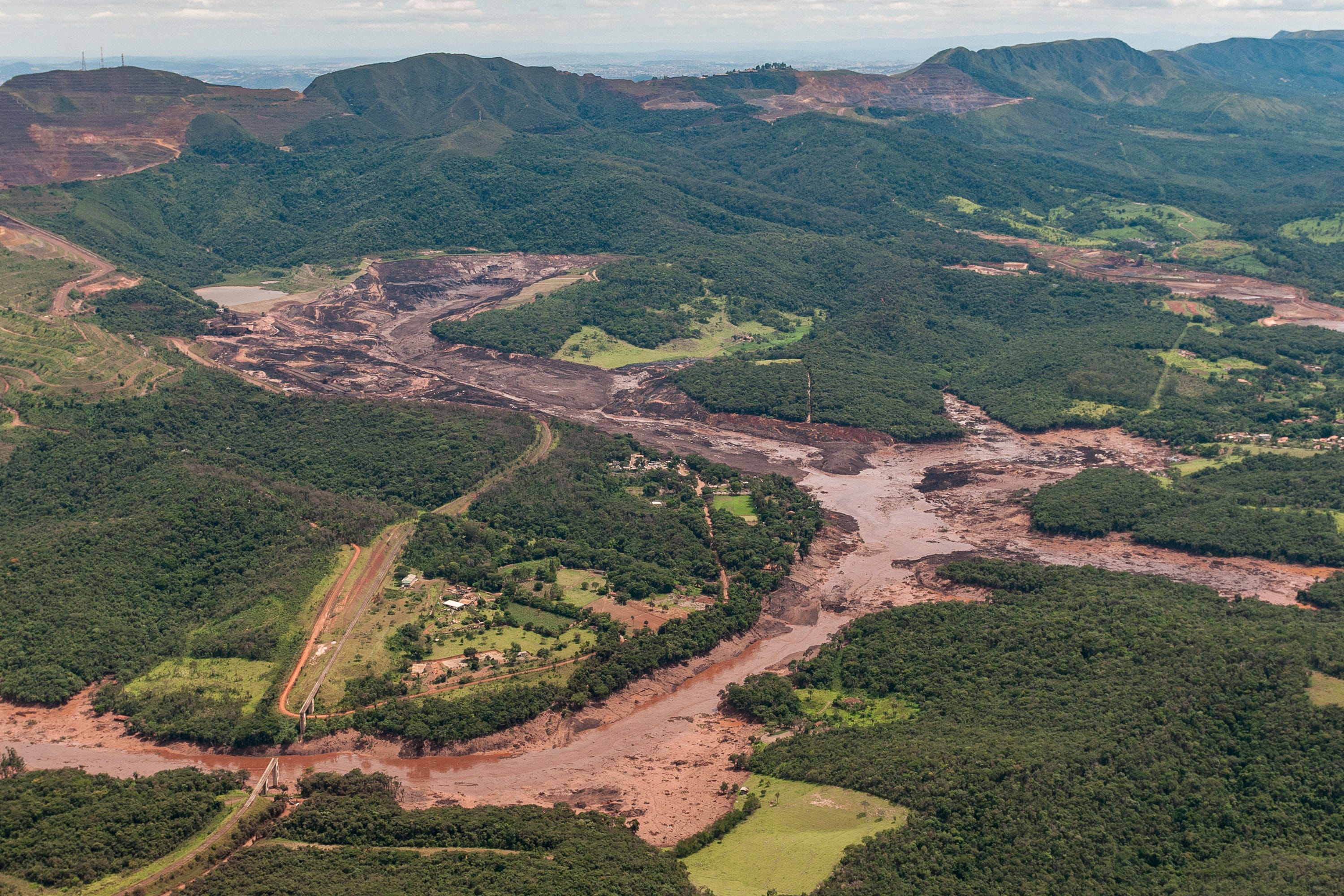
Poisonous slurry after the Brumadinho dam disaster, Minas Gerais. Photo by Ibama from Brazil.
I know what grouting is too! As a music student I enjoyed that our boring Music History Survey textbook (old-school before 21st century curriculum revamps) was written by DONALD GROUT. I taped a magazine clipping of an ad for bathtub grout on its cover. The ad said "GROUT GONE?" I wished...and eventually got my wish. Now I think, how apt his name was, given we were, really, "grouting" our "foundation" in Western music history. I smelled a rat in the basement even then, lol.
Admire me. I drove through snowflakes to fetch the mail today. And am reading I Will Live For Both Of Us : A History of Colonialism , Uranian Mining , and Inuit Resistance.
The Federal and Provincial Governments call our left behind still polluting mines ' orphaned and abandoned' as if they are hurt children. Hundreds of them leaking into Canadian waters. Yuck