
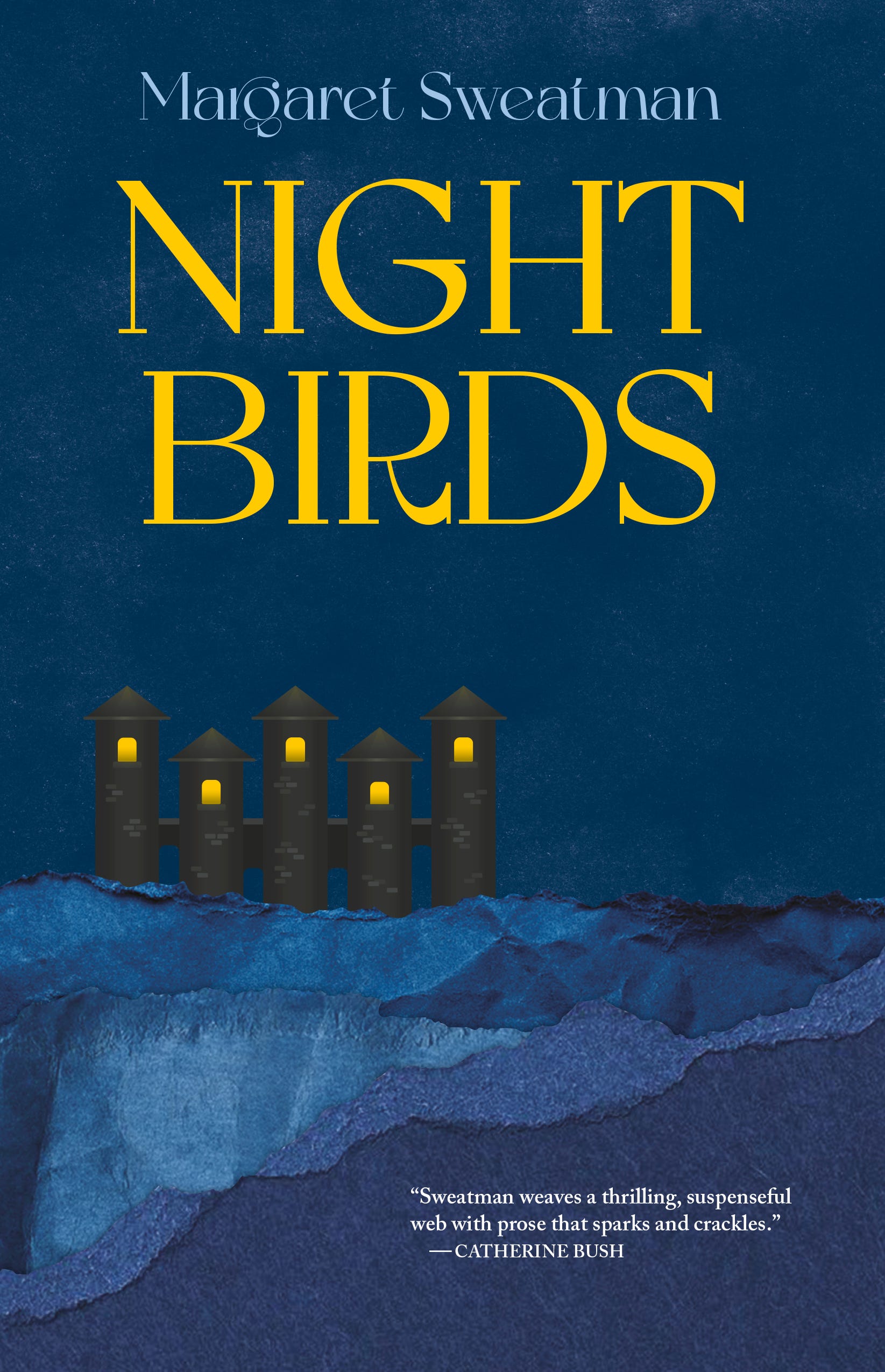
NIGHT BIRDS
This is the Prologue to my novel, published by Goose Lane Editions, 2026.

Prologue
August 25, in the near future.
In the mountains of Transylvania, on a small, subsistence farm, a wood bench has been resting in the shade of the cherry orchard for twenty-five years. Pigs and sheep, with the deep assurance of domesticated food, snuffle, gorge, bleat behind chicken wire wrapped around willow stakes. Five dairy cows, sway-hipped and sun-dappled beneath hedges of wild elderberry, saunter slowly toward the creek that runs below the plaster-and-wood farmhouse. Bees buzz in clover near the apiary. It’s a rare morning of sunshine after weeks of heavy rain, and the air smells sweet, overripe.
The farmhouse rests in a valley in the Apuseni range, beneath a mountain top that has been lopped off, a surgical excision, a mastectomy, exposing raw ferrous stone and pink-orange copper, and other minerals, pale yellow pyrite, blue celestine, lustrous schist, a massive scar. The open pit mine is four-and-a-half kilometers in diameter and three hundred meters deep, a tawny coil of terraces.
This gold mine uses a heap-leaching technique, scraping ore and placing it on two massive open-air pads built to hold about seven million tonnes of rock. The ore is irrigated with cyanide and left alone for a couple of months while the cyanide leaches down to a base formed – it will one day be argued in court – of impermeable clay. Over the next several months, the cyanide solution drains through the leach pads to be collected in wells that lead to the plant where the gold is extracted. The tailings, waste material rich with cyanide, are pumped into a basin extending over a hundred acres, protected by a dam. Because the mine has been in full operation for a year, and because of the relentless rain this summer, the tailing basin brims with sludge, pressing against the dam.
The mine employs five hundred people from a commune of forty-odd villages linked by telegraph wires winding through low, grey-green mountains. Today, at noon, an employee – a miner, aged thirty-eight, with a wife and four children at home – is walking beneath the rim of the basin when he feels the rumble of drilling on the slope of the pit. The rumble begins like a heart murmur and soon grows so loud that, when he screams, he can’t hear himself, he’s just a weevil in a sack of barley, and he’s alive long enough to see the tailing basin dissolve in clouds of russet waste mixed with sand and stone and water, a tsunami of minerals and heavy metals, cyanide and zinc, sylvanite, calaverite, awash in several hundred thousand cubic meters of slurry that’s now moving down the mountain slope at a rate of ten kilometers an hour, engulfing the engineer and rolling down and over the administrative Quonset where fifty miners are having lunch in the cafeteria, sweeping them away along with the cars and trucks parked in the lot half a kilometer away, and twelve men who are trying to outrun the flood, and on down the mountain to the creek where the five dairy cows fall down dead into the red water, flowing on to the river, killing all the fish in the river and in the lake, killing cormorants, cranes and foxes and any carnivore who feeds in the wild, on through the river’s tributaries that flow into the Danube where fish float to the surface and a white horse drinks and lurches into the river-current, and every well in the region is poisoned for nearly two generations to come.
In Bristol, in southwest England, far from the Apuseni Mountains, Peter Zugravi, owner of the gold mine, gets a phone call. He listens, hangs up, thoughtfully lights a cigar and dials his accountant, then his lawyer. At his mine in Romania, the dead are pried in pieces from the sludge. Slings loaded with body parts dangle from helicopters, blood and fluid drizzling down onto the orange suits of the rescue workers, and that night, long, long before the corpses can be reassembled and tallied, comes another hard rain.
wow
Brilliant issue based writing. Clear and compelling.